
The World’s Deepest Hole: Hidden Beneath a Rusty Cap
Exploring the legendary Kola Superdeep Borehole in Russia
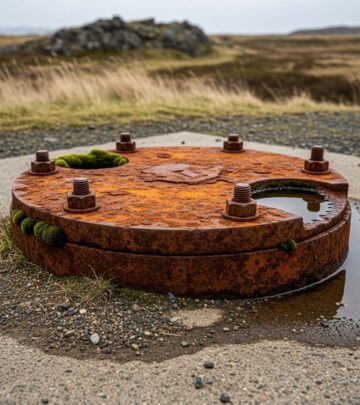
In the remote wilderness of northwestern Russia, near the Norwegian border, lies one of humanity’s most ambitious and extraordinary scientific endeavors. At first glance, it appears utterly unremarkable—just a rusted, bolted-shut metal cap sitting inconspicuously on the frozen landscape of the Kola Peninsula. Yet beneath this unassuming cover lies the Kola Superdeep Borehole, the deepest human-made hole on Earth, plunging an astounding 40,230 feet (12,262 meters) into our planet’s crust.
This remarkable achievement, initiated during the height of the Cold War, represents far more than just a hole in the ground. It stands as a testament to human curiosity, technological innovation, and the relentless pursuit of scientific knowledge. The borehole offered scientists an unprecedented glimpse into the Earth’s interior, revealing secrets that had remained hidden for billions of years and challenging long-held assumptions about our planet’s composition.
A Cold War Scientific Race
While the world watched the dramatic space race between the United States and the Soviet Union unfold in the skies above, a parallel competition was taking place far below the surface. During the 1960s, both superpowers became intensely interested in drilling as deeply as possible into the Earth’s crust, driven by scientific curiosity and geopolitical rivalry. The Soviets were determined to demonstrate their technological prowess and scientific capabilities, not just in space exploration but also in understanding the very planet beneath their feet.
The Kola Superdeep Borehole project began in May 1970 in the Pechengsky District of the Kola Peninsula, approximately 155 miles north of the Arctic Circle. This remote location in Murmansk province, situated near the borders with Finland and Norway and the Barents Sea, became the site of one of the most ambitious drilling operations ever attempted. The project was part of a broader Soviet scientific research program that included other superdeep boreholes, though none would achieve the depths reached at Kola.
The drilling operation was conceived as a symbol of Soviet scientific ambition and determination to match, if not surpass, Western achievements. In an era of fierce competition, the borehole represented more than just a scientific endeavor—it was a statement of technological supremacy and national pride.
The Engineering Marvel Behind the Drill
Creating the world’s deepest hole required revolutionary engineering solutions and technological innovations that would ultimately transform the drilling industry. The initial drilling began using the Uralmash-4E drilling rig, later upgraded to the more advanced Uralmash-15000 series. The project’s engineers faced unprecedented challenges that demanded creative problem-solving and the development of entirely new drilling technologies.
Originally, the project aimed to reach a vertical depth of 49,213 feet (15,000 meters or 9.32 miles), though this goal would prove impossible to achieve. The trajectory of the hole was designed to be as vertical as possible to minimize torque on the drill string, but the extreme depths involved created problems that conventional drilling methods couldn’t solve.
The most significant innovation was the development of a revolutionary rotary drill bit. Traditional drilling methods involved twisting the entire drill pipe to turn the bit, but at the depths planned for Kola, the drill string would weigh over a million pounds—far too much weight to rotate effectively. Soviet scientists ingeniously invented a rotary bit that could spin independently at the end of the drill pipe. Pressurized drilling mud caused the bit to spin while the drill pipe simply slid down the hole, eliminating the need to rotate the massive weight of the entire string.
Additionally, engineers had to develop specialized geophysical logging tools capable of withstanding the incredible pressures and temperatures encountered at such extreme depths. These innovations didn’t just serve the Kola project—they led directly to the development of modern drilling equipment and well logging tools that revolutionized oil and gas exploration worldwide.
Descending Into the Unknown
The borehole itself consisted of multiple holes branching off from a central shaft, with the deepest branch—designated SG-3—reaching the record depth of 12,262 meters in 1989. Despite its incredible depth, the diameter of the hole never exceeded 9 inches (23 centimeters), making it narrower than a dinner plate.
To put this achievement in perspective, the hole’s depth exceeds the height of Mount Everest and Mount Fuji stacked on top of each other. It plunges deeper than the Mariana Trench, the deepest point in the world’s oceans, which lies at 36,201 feet (11,034 meters) below sea level. The drilling operation traversed approximately 1.4 billion years of Earth’s geological history, providing an unprecedented temporal cross-section of our planet’s crust.
For nearly three decades, from 1979 until 2008, the Kola Superdeep Borehole held the distinction of being not only the deepest but also the longest borehole measured along its bore. It was eventually surpassed in measured depth by a hydrocarbon extraction borehole at the Al Shaheen Oil Field in Qatar, though Kola remains the deepest in terms of true vertical depth.
Unexpected Scientific Discoveries
The scientific revelations uncovered by the Kola Superdeep Borehole proved to be some of the most valuable outcomes of the entire project. Scientists made several groundbreaking discoveries that challenged existing geological theories and expanded our understanding of Earth’s interior composition and structure.
The Mystery of the Missing Layer: One of the most surprising findings was the absence of the “Conrad discontinuity,” a theoretical transition zone where granite was expected to give way to basalt at depths of about 3 to 4 miles. Scientists had long believed this boundary existed based on seismic data, but direct drilling revealed that this transition did not occur as predicted. The rocks remained predominantly granitic far deeper than anticipated, forcing geologists to reconsider their models of crustal composition.
Water in Impossible Places: Perhaps the most astonishing discovery was the presence of liquid water at depths where it was assumed to be impossible. The deep rocks were found to be saturated with water, despite being sealed beneath layers of supposedly impermeable rock. This finding revolutionized understanding of how water circulates through the Earth’s crust and raised new questions about the planet’s hydrological systems at extreme depths.
Ancient Life Forms: Scientists discovered 14 species of fossilized microorganisms in the deep rock samples, including microscopic fossils from single-celled marine organisms dating back approximately 2 billion years. These ancient remnants of life provided invaluable insights into the evolution of early organisms and the conditions that existed on Earth billions of years ago.
Mineral Wealth: The drilling operation also revealed unexpected deposits of valuable minerals, including gold, copper, and nickel at depths previously unexplored. These discoveries demonstrated that significant mineral resources might exist far deeper in the Earth’s crust than mining operations had traditionally reached.
The Challenges That Stopped Progress
Despite the remarkable achievements and groundbreaking discoveries, the Kola Superdeep Borehole project ultimately faced insurmountable obstacles that prevented it from reaching its original target depth. As drilling progressed deeper into the Earth’s crust, conditions became increasingly hostile and challenging.
The primary obstacle was extreme temperature. At the final depth of approximately 7.6 miles, temperatures reached a blistering 356°F (180°C)—far higher than the 212°F (100°C) that scientists had anticipated based on their initial models. This intense heat made drilling increasingly difficult and posed severe challenges for equipment durability and function.
Additionally, the rock at these depths exhibited unexpected properties. Rather than becoming harder and more compact as predicted, the rock became more plastic and deformable, behaving almost like a thick fluid under the immense pressure and heat. This plasticity caused the hole to close in on itself and made maintaining the borehole’s integrity increasingly difficult. The drill bit would often become stuck, requiring time-consuming and expensive retrieval operations.
These combined factors—extreme temperatures, increasing rock density, and the plastic behavior of the deep rocks—made further progress prohibitively expensive and technically impractical. In 1992, after more than two decades of drilling, the project was officially discontinued. The site remained accessible for several more years, but in 2005, the borehole was permanently sealed with the rusty metal cap that covers it today.
The Legend of the “Entrance to Hell”
No discussion of the Kola Superdeep Borehole would be complete without addressing one of the most persistent and bizarre urban legends associated with it. According to a widely circulated rumor, the project was supposedly shut down because scientists accidentally drilled into a superhot cavern that some claimed was the entrance to hell itself.
The legend suggests that when the drill broke through into this mysterious cavern, scientists lowered a heat-resistant microphone into the void to investigate. Upon playback, they allegedly heard what sounded like the anguished screams and tormented howls of countless souls suffering in eternal damnation. This sensational story spread rapidly, particularly in certain religious circles, and the borehole earned the ominous nickname “entrance to hell.”
Of course, this story is entirely unverified and almost certainly fabricated. There is no credible scientific evidence to support these claims, and the actual reasons for the project’s termination—rising temperatures, increasing costs, and technical difficulties—are well-documented and entirely mundane. Nevertheless, the legend persists, demonstrating how extraordinary human achievements can sometimes become the subject of fantastical myths and conspiracy theories.
The Lasting Legacy
Although the Kola Superdeep Borehole has been sealed and abandoned for two decades, its scientific and technological legacy continues to resonate throughout the geological and drilling industries. The project provided invaluable data about the composition and structure of the Earth’s crust, challenged fundamental assumptions about our planet’s interior, and demonstrated the limits of our ability to directly explore the depths beneath our feet.
The technological innovations developed for the Kola project—particularly the rotary drill bit and advanced logging tools—became standard equipment in the oil and gas industry, enabling deeper and more efficient resource extraction worldwide. The project also highlighted the importance of international scientific cooperation and the value of pure research driven by curiosity rather than immediate commercial gain.
The New Race to the Deep
While the Cold War era of scientific rivalry has ended, the competition to explore Earth’s interior has not. The geopolitical landscape has shifted, but the drive to understand what lies beneath the surface remains a stage for competing nations to demonstrate their technological capabilities and scientific prowess.
Today, China has emerged as a new player in deep Earth exploration. In November 2024, China launched Meng Xiang, a massive scientific research vessel equipped with unprecedented drilling capabilities. This state-of-the-art ship can drill up to 11 kilometers (6.8 miles) beneath the seafloor, approaching the depths achieved by the Kola borehole but targeting oceanic rather than continental crust.
China’s investment in deep drilling technology reflects a broader trend of renewed interest in understanding Earth’s interior. As climate change, resource depletion, and population growth create increasing pressures on our planet, understanding the deep Earth’s structure, composition, and processes becomes ever more critical for sustainable resource management and environmental protection.
What the Future Holds
The Kola Superdeep Borehole demonstrated both the incredible potential and significant limitations of drilling technology for exploring Earth’s interior. While direct drilling provided invaluable insights that could not be obtained any other way, it also revealed that reaching truly deep portions of the Earth’s crust—let alone the mantle—remains far beyond current technological capabilities.
Future efforts to understand Earth’s deep interior will likely combine multiple approaches. Advanced seismic imaging, computer modeling, laboratory experiments simulating deep Earth conditions, and strategic drilling operations will work together to build a more complete picture of our planet’s structure and composition. Each method compensates for the limitations of the others, providing a more comprehensive understanding than any single technique could achieve alone.
The story of the Kola Superdeep Borehole reminds us that some of the most profound mysteries lie not in distant galaxies or on other planets, but right beneath our feet. Despite living on Earth’s surface for our entire existence as a species, we have barely scratched the surface—quite literally—of understanding the planet we call home.
Frequently Asked Questions (FAQs)
Q: How deep is the Kola Superdeep Borehole?
A: The Kola Superdeep Borehole reaches a depth of 40,230 feet (12,262 meters or 7.6 miles), making it the deepest human-made hole on Earth. To put this in perspective, it’s deeper than the Mariana Trench and exceeds the height of Mount Everest and Mount Fuji combined.
Q: Why was the Kola Superdeep Borehole sealed?
A: The project was discontinued in 1992 due to extreme temperatures reaching 356°F (180°C), increasing costs, and technical difficulties caused by the plastic behavior of rocks at great depths. The hole was permanently sealed in 2005. The urban legend about drilling into hell is completely false.
Q: What important discoveries were made at the Kola Superdeep Borehole?
A: Scientists discovered that the Conrad discontinuity (the expected granite-to-basalt transition) didn’t exist as predicted, found liquid water at impossible depths, uncovered 14 species of fossilized microorganisms up to 2 billion years old, and detected deposits of gold, copper, and nickel.
Q: Can visitors see the Kola Superdeep Borehole today?
A: The borehole is located in a remote area of northwestern Russia near the Norwegian border. While the site is sealed and abandoned, the rusted metal cap that covers the hole remains visible. However, access may be restricted due to its remote location and security considerations.
Q: Is anyone currently attempting to drill deeper than the Kola Superdeep Borehole?
A: While no project has yet surpassed Kola’s vertical depth, China launched the research ship Meng Xiang in November 2024, capable of drilling up to 11 kilometers (6.8 miles) beneath the seafloor. Several nations continue to pursue deep drilling projects for both scientific and resource extraction purposes.
Q: How long did it take to drill the Kola Superdeep Borehole?
A: Drilling began in May 1970 and continued for approximately 20 years, reaching its maximum depth in 1989. The project was officially discontinued in 1992, making it roughly a 22-year endeavor. The extreme conditions and technical challenges meant progress was often slow and sometimes required redrilling sections.
References
- https://science.howstuffworks.com/engineering/civil/kola-superdeep-borehole.htm
- https://www.iflscience.com/the-deepest-hole-ever-dug-by-humans-had-to-be-destroyed-68110
- https://en.wikipedia.org/wiki/Kola_Superdeep_Borehole
- https://www.youtube.com/watch?v=n7PSUOk9Nq0
- https://www.earthdate.org/episodes/kola-superdeep
- https://www.youtube.com/watch?v=6Od6PDbl-RQ
Similar Articles








Read full bio of medha deb


