
Canada and Denmark’s Whisky War: How Two Nations Fought for a Rock With Rye and Schnapps
Explore the 50-year amicable border dispute between Canada and Denmark over Hans Island, settled with whisky, flags, and diplomacy.
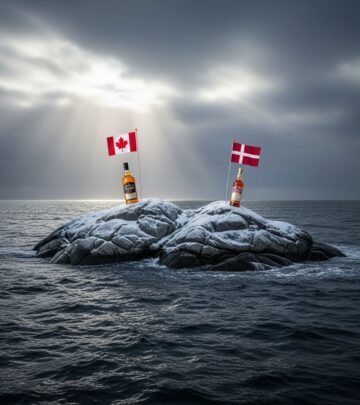
Canada and Denmark’s Whisky War: A Diplomatic Dispute on the Rocks
For nearly fifty years, Canada and Denmark waged one of the world’s friendliest and most unusual territorial disputes over a tiny Arctic outcrop known as Hans Island, or Tartupaluk in Greenlandic. Instead of resorting to military force or heated rhetoric, the two nations engaged in a playful rivalry fueled by flags, camaraderie, whisky, and schnapps—leading many to dub it the “Whisky War.” This remarkable story stands as a testament to peaceful conflict resolution and international good humor, ultimately concluding in 2022 with an agreement that divided the island between both countries, setting a new standard for diplomatic resolve.
What is Hans Island?
Hans Island is a small, barren rock in the Kennedy Channel of the Nares Strait, situated between Canada’s Ellesmere Island and Greenland—an autonomous territory belonging to Denmark. Covering a mere 1.3 square kilometers, the island lies about 18 kilometers off Greenland’s coast and 35 kilometers from Canada. The island is treeless, windswept, and largely lifeless, yet proved symbolically significant for both claimants.
- Greenlandic Inuit have hunted on and around Hans Island for generations, grounding Denmark’s claim through cultural connection and proximity.
- Canada’s claim traces back to the Hudson’s Bay Company transfer of Arctic lands to Canadian sovereignty in the late 19th century.
Origins of the Dispute
The roots of the Whisky War date to 1973, when Canada and Denmark sought to define their Arctic maritime boundary through the Nares Strait. Negotiators drew a line that split Hans Island in two, but neither country would cede ground, leaving the fate of the tiny territory unresolved. For decades, both sides quietly asserted ownership, culminating in a whimsical, good-natured standoff.
The Whisky War: Flags, Bottles, and Playful Rivalry
Unlike typical border disputes marked by tension or conflict, the “Whisky War” took its name from the lighthearted tradition of each country’s military or diplomatic teams landing on Hans Island to:
- Replace the other nation’s flag with their own.
- Leave a bottle of national spirits behind—usually Canadian whisky or Danish schnapps—for the next visitors.
- Occasionally leave friendly notes or greetings, poking fun or acknowledging the ongoing game.
This enduring ritual became emblematic of a non-combative, almost sporting approach to international disagreements. Military helicopters or boats would periodically deliver personnel to raise flags and deposit bottles, only for the process to be repeated by the other side weeks or months later. The cycle continued, punctuated by smiling photos and diplomatic statements rather than threats or escalation.
Why Was Hans Island Important?
- Symbolic Value: Both countries viewed Hans Island as a test of sovereignty and commitment to Arctic territorial claims.
- Strategic Location: The island sits directly between Canada and Greenland, marking the boundary between North American and European continental shelves, and potential resource interests in the Arctic.
- Cultural Connections: The Inuit communities of Greenland and Arctic Canada have historical ties to the region.
Despite its inhospitable conditions—so barren as to be ‘hardly worth fighting for’—Hans Island assumed outsized importance in public imagination and governmental symbolism, especially as global attention toward the Arctic and its resources grew.
Legal Background: Treaties, Borders, and Sovereignty
The legal wrangling over Hans Island has roots stretching back well over a century. Key historical moments include:
- 1880 – Transfer of Hudson’s Bay Company lands to Canada, which included the high Arctic territories bordering Greenland.
- 1917 – U.S. recognition of Danish sovereignty over northern Greenland, following the purchase of the Virgin Islands. This recognized Danish claims to the region but did not settle the specific border with Canada.
- 1973 – Canada-Denmark Maritime Boundary Treaty: While most of the boundary between Ellesmere Island (Canada) and Greenland was defined, the line split Hans Island itself, leaving the rock’s sovereignty unresolved.
Both countries periodically reiterate their rights to Hans Island through official statements, visits, and the famous flags-and-spirits exchange. For Denmark, the claim is bolstered by Greenlandic Inuit usage; for Canada, historic treaties and transfers provide their legal basis.
The Resolution: Diplomacy Triumphs
After decades of playful one-upmanship, Canada and Denmark finally reached a formal agreement in June 2022. This historic decision, announced in Ottawa and celebrated with yet another exchange of national spirits, divided the island evenly down the middle, establishing the first ever land border between Canada and Denmark—and extending the world’s longest maritime border by nearly 4,000 kilometers.
- Canadian Foreign Minister Mélanie Joly: “It brings a lot of clarity.” The diplomatic outcome, she emphasized, sets a peaceful example for the world.
- Danish Foreign Minister Jeppe Kofod: Celebrated the solution with Greenlandic Prime Minister Múte B. Egede, highlighting a shared commitment to diplomacy and the rule of law.
- Historic Ceremony: The conclusion involved the ceremonial exchange of Sortilège maple whisky (Canada) and Gammel Dansk bitter (Denmark/Greenland), symbolizing the good-natured rivalry and final agreement.
The agreement, reached amidst global tension and following Russia’s invasion of Ukraine, was lauded as a template for resolving international disputes through negotiation, not force.
Implications of the Agreement
| Aspect | Canada | Denmark/Greenland |
|---|---|---|
| Sovereignty | Receives half of Hans Island | Receives half of Hans Island |
| Maritime Border | World’s longest, ~4,000 km | World’s longest, ~4,000 km |
| International Relations | Showcase of peaceful diplomacy | Showcase of peaceful diplomacy |
Rye Whisky, Regulations, and Labeling Controversy
Hans Island isn’t the only issue where Canada and Denmark have crossed paths in the whisky world. International agreements relating to rye whisky labeling have generated confusion and frustration among European producers—especially Danish distilleries.
- 2003 EU-Canada Agreement: European whiskey makers are prohibited from labeling their rye products as “rye whisky” to protect the Canadian category—even though many Canadian whiskies contain little or no rye.
- This rule, largely unnoticed for two decades, does not reflect European traditions, where rye has been central to food and spirits for centuries.
- Industry Reaction: Danish distilleries like Stauning have protested by selling bottles labeled only “Censored” to draw attention to the issue, while continuing to make high-quality rye whisky.
Efforts are underway by Danish producers and politicians, supported by SME organizations, to challenge and renegotiate the agreement, aiming for rational rules that reflect actual practices and serve both tradition and commerce.
Definition of Canadian Rye Whisky
- Canadian regulations allow almost any whisky made or aged in Canada to be labeled “rye whisky,” including blends, single malts, single grains, cask-finished, and even flavored whiskies.
- The product must be mashed, distilled, and aged in Canada for at least three years in small wooden casks and maintain at least 40% alcohol by volume during production.
- This leads to interchangeability between “whisky” and “rye whisky” in Canada—a situation criticized abroad for being overly lax.
Friendship, Flags, and Whisky: International Lessons Learned
The resolution of the Whisky War and the ongoing regulatory discussions offer important international lessons:
- Peaceful Problem-Solving: The Hans Island agreement shows how nations can resolve territorial disputes amicably and set positive precedents for the rest of the world.
- Protecting Tradition and Identity: The debate around rye whisky shows the importance of respecting local heritage and practices, particularly in policies that affect global commerce.
- Symbolic Diplomacy: The exchange of flags and bottles transformed a potential flashpoint into a symbol of good humor and mutual respect.
Frequently Asked Questions (FAQs)
Q: Why was Hans Island disputed for so long?
A: Both Canada and Denmark had valid legal and historical claims stemming from overlapping treaties and uses, compounded by the island’s position directly on their agreed maritime boundary. The lack of major strategic or economic value made a protracted, friendly dispute possible.
Q: Was there ever any violence on Hans Island?
A: No. The disagreement was never militarized. Instead, it was characterized by flag swapping, bottle leaving, and occasional notes or lighthearted gestures, making it “the friendliest territorial dispute in history.”
Q: What does the final agreement mean for Canada and Denmark?
A: The 2022 agreement means that the island is officially split, creating a new land border and the world’s longest maritime border—setting a diplomatic example for peaceful resolution.
Q: Why is rye whisky labeling controversial between the EU and Canada?
A: A 2003 EU-Canada agreement restricts EU whisky makers from labeling their products as rye whisky, even though Canadian rules allow broad use of the term. European producers, especially in Denmark, have called for changes to better reflect their traditions and market realities.
Q: Is Hans Island inhabited or valuable?
A: No, Hans Island is uninhabited, rocky, and offers little practical value—its importance is mainly symbolic, as a marker of sovereignty and diplomatic prowess.
Legacy of the Whisky War
The story of Hans Island is more than an odd historical footnote—it’s a celebration of peaceful conflict resolution and the ability of countries to prioritize civility over confrontation.
- Diplomatic Role Model: The friendly end to the Whisky War demonstrates how even deeply rooted disputes can be solved through dialogue, mutual respect, and a sense of humor.
- Cultural Connections: Local traditions, such as the use of rye in European food and spirits, reflect the complexities of international agreements on labeling and nomenclature.
- Changing Arctic: As climate change and shifting geopolitics bring renewed attention to the Arctic, the resolution on Hans Island shows that even in contested regions, diplomacy can prevail.
In the end, the Whisky War was not just a quarrel over a rock—it was a celebration of international goodwill, clever negotiation, and the power of a well-placed bottle.
References
- https://nunatsiaq.com/stories/article/canada-denmark-make-peace-in-whisky-war/
- https://www.thespiritsbusiness.com/2025/04/eu-can-no-longer-label-rye-whisky-rye-whisky/
- https://blogs.loc.gov/law/2022/06/the-hans-island-peace-agreement-between-canada-denmark-and-greenland/
- https://eastangliabylines.co.uk/lifestyle/history/the-amazing-whisky-war-the-friendliest-territorial-dispute-in-history/
- https://en.wikipedia.org/wiki/Whisky_War
- https://www.thearcticinstitute.org/legal-implications-2022-canada-denmark-greenland-agreement-hans-island-tartupaluk-inuit-peoples-greenland-nunavut/
Similar Articles






Read full bio of medha deb


