
Mysterious Albino Redwoods: Nature’s Wonders
Exploring the Enigmatic and Adaptive World of White Redwoods
Introduction to Albino Redwoods
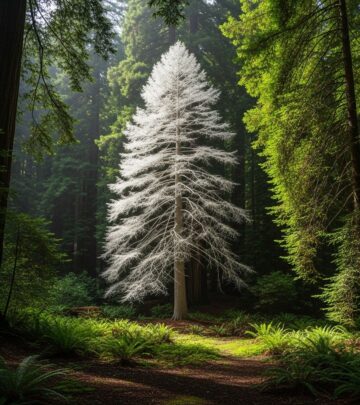
Albino redwoods, also known as ”ghost redwoods,” are a rare and fascinating phenomenon in the redwood family. These trees are unable to produce chlorophyll, giving them a characteristic white appearance instead of the usual green foliage seen in most redwoods. This condition makes them incapable of photosynthesis, forcing them to rely on adjacent trees for nutrients.
Biological Adaptation
Chlorophyll Deficiency is the primary reason for the white coloration of albino redwoods. Without chlorophyll, these trees cannot photosynthesize and thus cannot produce their own food. This critical limitation necessitates an unusual adaptation to survive.
Shared Roots play a crucial role in the survival of albino redwoods. They share roots with nearby normal redwoods, allowing them to obtain sugars necessary for growth. This symbiotic relationship is a testament to nature’s intricate web of life.
Types of Albino Redwoods
Research has identified several
phenotypes
of albino redwoods, including white, bright yellow, cellular virescent green, pale green, mottled, and nonchimeric variegated. These variations indicate that albinism in redwoods is not a single, uniform condition but can manifest in diverse ways.- White Albino Redwoods are the most common form, lacking chlorophyll completely.
- Bright Yellow forms are associated with excess xanthophyll production and are found only in aerial (branching) forms.
- Cellular Virescent Green forms have a mix of normal and mutant cells, leading to a greenish hue.
Conservation Status and Cultural Significance
Albino redwoods are extremely rare, with only about 400 known worldwide. Their locations are often kept confidential to protect these unique trees from disturbance and damage.
These trees hold significant
cultural importance
, particularly among Native American communities. For example, the Pomo people have used albino redwoods in traditional cleansing ceremonies.Role in the Ecosystem
Recent research suggests that albino redwoods may serve as toxic waste dumps for their ecosystems. They accumulate toxins from the soil, which could otherwise harm nearby trees. This unique role highlights their importance in maintaining ecological balance.
Frequently Asked Questions (FAQs)
Q: What causes albino redwoods to lack chlorophyll?
A: The lack of chlorophyll in albino redwoods is due to a genetic mutation that affects the production of pigments necessary for photosynthesis.
Q: How do albino redwoods survive if they cannot photosynthesize?
A: Albino redwoods survive by obtaining nutrients through root connections with nearby normal redwood trees.
Q: Are albino redwoods found only in California?
A: While most known albino redwoods are found in California, they can potentially occur anywhere that redwoods are present, although documented cases are extremely rare outside this region.
Conclusion
Albino redwoods are a fascinating example of nature’s adaptability and resilience. Their unique dependence on other trees for survival highlights the intricate relationships within ecosystems. Continued research and conservation efforts are crucial to understand and protect these enigmatic trees.
References
- https://en.wikipedia.org/wiki/Albino_redwood
- https://sempervirens.org/news/ghost-redwoods-solving-the-albino-redwoods-mystery/
- https://www.savetheredwoods.org/blog/wonders/a-perspective-on-albino-redwoods/
- https://www.visitredwoods.com/listing/albino-redwoods-a-winter-treat/14/
- https://www.yournec.org/creature-feature-albino-redwood/
- https://www.youtube.com/watch?v=os5mZQLpe98
Similar Articles







Read full bio of Sneha Tete


